
Line Dash
SATORISYS PLAYCasual
4.7594.00 Reviews
- Version
- 1.1.3
- Installs
- 100.00K
- Age Rating
- Everyone
Screenshots
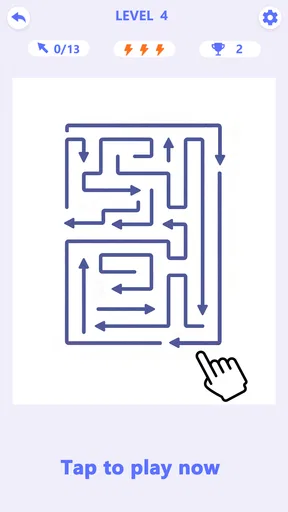
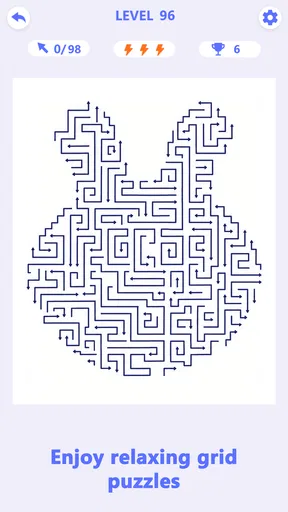

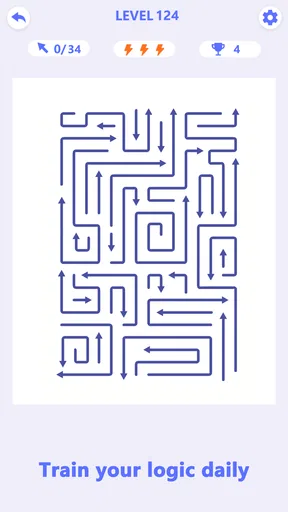
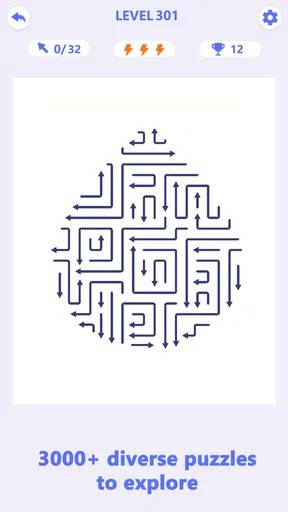
Our Review of Line Dash
 Analysis by Appyee
Line Dash is the kind of casual puzzle game I can open for a few minutes without needing to learn a complicated system first. Its central idea is simple: tap lines, work out paths, and use logic to reach a solution. That simplicity is also the game’s main strength and its main limitation. I found it easy to understand, pleasant for short sessions, and more mentally engaging than many tap-to-pass casual games, but it is not designed for players looking for a deep story, extensive customization, or a large competitive framework.
Developed by SATORISYS PLAY, this free game sits in the casual category and is suitable for Everyone. Its store summary points directly to the experience: solving paths through line-based puzzles rather than managing characters, resources, or a long progression system. With a 4.7 average from around 13 thousand ratings and more than 100 thousand installs, it has already attracted a sizeable audience for such a focused concept. I think that reaction makes sense, especially for people who enjoy quick logic challenges that can fit around a normal day.
How the line puzzles feel in everyday play
The first thing I noticed is how quickly the game communicates its basic rule. There is no need to spend a long time reading instructions before trying a puzzle. The visual language is direct: lines form a route, the player taps, and the challenge comes from deciding the correct sequence or connection. That low entry barrier matters on mobile, where I often want to start playing immediately rather than study a tutorial.
Although the controls are straightforward, the decisions are not always automatic. A path can look obvious at first and then become less certain when several lines appear to interact. The best moments come when I stop tapping impulsively and examine the whole arrangement before committing. That gives the game a useful rhythm: observe, test a possibility mentally, make a move, and reassess the result.
The strongest part of the design is the gap between simple input and thoughtful decision-making. Tapping is effortless, but a careless tap can reveal that I misunderstood the route. This makes Line Dash more satisfying than a casual game where every action is interchangeable. Even when a puzzle is short, it can still ask for attention.
I found it particularly suitable for small breaks. A short session during a commute, while waiting for an appointment, or between household tasks does not require the same commitment as a traditional adventure game. I can pick it up, focus on a path, and put it down without feeling that I have abandoned a complicated storyline or left a team waiting for me.
That convenience also helps explain why the game can appeal to different ages. The Everyone rating matches the approachable concept, and the rules are easy enough for a younger player to grasp while still leaving room for adults to make mistakes through overthinking or rushing. I would still expect the difficulty experience to depend heavily on the individual player, since people who regularly play logic puzzles may move through familiar patterns faster.
Why the simple format works better than it sounds
Line-based puzzle games can seem too narrow when described in one sentence, but the limitation gives this title a clear identity. There are no unrelated systems competing for attention. The screen is about the arrangement in front of me and the route I need to understand. That focus is refreshing compared with casual games that surround a basic mechanic with currencies, collection screens, timers, and constant distractions.
One useful habit is to treat each board as a visual problem before treating it as a tapping problem. I get better results when I trace possible routes with my eyes, identify where a line appears to force a decision, and only then interact with the puzzle. This approach reduces random taps and makes the logic feel more deliberate. It is a small change, but it turns the game from something I merely react to into something I actively solve.
Another practical use is as a mental reset. I would not describe it as a formal brain-training tool, and I would not use it to replace a full puzzle collection, but it gives me a compact task that demands enough concentration to interrupt idle scrolling. The best time to play is when I want a little focus without the emotional investment of a longer game.
There is also a nice trade-off in the visual simplicity. Because the concept depends on lines and paths, clarity is more important than spectacle. Players who enjoy clean puzzle layouts may appreciate that emphasis. Players who need animation, character expression, or a strong sense of place may find the presentation too restrained. The game’s appeal depends on whether the puzzle itself is enough to hold attention.
A realistic short-session example
Imagine opening the game while waiting for a friend who is running late. I would rather solve several compact path problems than start a story-driven game that needs uninterrupted time. Line Dash fits that situation because the objective is immediately visible, and the session can remain focused on the current puzzle instead of requiring preparation.
If I became stuck, I would first stop tapping and look for the route that has the fewest alternatives. In line puzzles, a segment with only one plausible continuation can often anchor the rest of the solution. From there, I would work outward rather than guessing at the most visually prominent line. This is not a guaranteed shortcut for every board, but it is a more reliable workflow than tapping until something happens.
That example also shows where the game may not suit everyone. If I only have time for a completely passive distraction, the need to inspect a route can feel like effort. Line Dash asks for attention even when the session is brief. For me, that is the point, but someone seeking an idle game may prefer a different casual format.
Where the experience is convincing and where it falls short
The game’s clearest success is its accessibility. I do not need specialist knowledge, a long memory of previous levels, or familiarity with a complicated control scheme. The concept can be understood through interaction, which is exactly what I want from a small mobile puzzle. The free price also makes it easy to try without turning the decision into a financial commitment.
Its current version is 1.1.3, and that gives the experience a relatively focused, early-stage feel rather than the impression of a massive, mature platform. I see that as neither automatically good nor bad. A focused game can be easier to approach, but players who expect years of accumulated modes and systems may find the scope modest.
The rating is encouraging, but I would not treat it as proof that every player will enjoy the same pace. A high average can tell me that the core idea works for many people, yet it cannot remove the central taste question: do I enjoy studying paths and making careful taps? If the answer is no, the strong reception will not change the basic nature of the game.
The meaningful weakness is limited variety in the central activity. Since the entire experience revolves around line navigation and logic, the game has to keep that one idea interesting. Players who need frequent changes of genre, narrative rewards, or elaborate unlocks may begin to feel that the format is repetitive. I would recommend trying it with that expectation in mind rather than assuming the short description promises a broad arcade package.
Another point of friction is the possibility of hesitation. A puzzle that looks simple can invite second-guessing, especially when several lines appear equally plausible. Some players enjoy that tension; others may interpret it as uncertainty in the interface. Clear visual feedback is therefore essential to the experience, because any ambiguity in a line’s role can make a logic challenge feel like a control problem.
For that reason, I would avoid playing when I am distracted by a loud environment or trying to multitask. The game is casual in format, but not necessarily mindless. A quiet moment makes it easier to inspect the entire board and notice relationships that are easy to miss when I am rushing.
Who should install it, and who should skip it
I think Line Dash is a strong match for players who like compact logic games, visual route puzzles, and mobile sessions that can begin without preparation. It is especially suitable for someone who wants a free game with a clear premise rather than a large collection of mechanics. It may also work well for families because the Everyone rating and simple tapping concept make it approachable across age groups.
I would recommend it to a friend who says, “I want something casual, but I still want to think.” That sentence captures the game better than calling it merely relaxing. It can be calming because the board narrows my attention, but solving a route still requires active observation. The experience is most rewarding when I am willing to pause and reason instead of treating every puzzle as a reflex test.
I would be more cautious about recommending it to players who measure value by content volume. Someone looking for character progression, a story campaign, online competition, or a wide range of minigames should probably choose a broader alternative. A traditional match-three game may be better for players who prefer constant visual feedback and quick chain reactions. A sudoku or nonogram app may be better for someone who wants a more established number- or grid-based logic routine. Line Dash sits between those choices: visual and immediate, but still dependent on deduction.
It is also not the right choice if I want a game that can run in the background while I listen to something else. The path arrangement is the content, so looking at the screen is not optional. That is a fair trade-off, but it is worth knowing before installing. The game rewards attention rather than passive repetition.
Practical ways to get more from each puzzle
My first tip is to scan for constraints before looking for the complete answer. Instead of trying to understand every line simultaneously, I search for endpoints, forced turns, or sections where only one connection seems possible. Solving the most restricted part first often makes the rest of the arrangement easier to read.
My second tip is to separate observation from action. I try to form a rough route in my head before tapping. This is useful because the game’s input is simple enough that the real challenge is not physical dexterity. The more I reduce accidental or speculative taps, the more clearly I can tell whether my reasoning was correct.
My third tip is to use mistakes as information rather than immediately restarting mentally. When a route fails, I ask which assumption caused the problem. Was I following a line because it looked prominent, or because the surrounding structure required it? That small review makes the next attempt more efficient and turns a wrong move into part of the solving process.
A fourth consideration is session length. I prefer several brief attempts to one long, frustrated sitting. If I stop after a difficult board and return later, the visual arrangement can feel fresh, and I am less likely to repeat the same assumption. This is especially useful for players who enjoy puzzles but dislike the pressure of forcing a solution immediately.
These habits are not hidden buttons or complicated techniques; they are ways of matching my play style to the game’s design. The store summary makes the concept sound immediate, but the better experience comes from slowing down enough to read the structure. That is the difference between tapping lines and actually solving paths.
How it compares with familiar casual alternatives
Compared with match-three games, Line Dash offers less instant spectacle but more visual planning. A match-three board encourages quick pattern recognition and chain reactions, while this game asks me to consider how a route fits together. If I want constant rewards and rapid movement, the match-three format may be more satisfying. If I want a quieter problem with fewer distractions, Line Dash has the advantage.
Compared with word puzzles, it avoids dependence on vocabulary and spelling. That makes its challenge more spatial than linguistic. Someone who enjoys arranging letters may find a word game more expressive, while someone who thinks naturally in shapes and connections may feel more at home here.
Compared with sudoku, the game appears more immediate because the visual route is presented directly rather than through a grid of numbers. Sudoku offers a deeper established logic vocabulary and often more control over difficulty styles, but it can feel formal or repetitive. Line Dash is easier to enter for a quick session, although its narrower line-based identity may provide less long-term variety for dedicated puzzle specialists.
Those comparisons help clarify the game’s real position. It is not trying to replace every kind of casual puzzle. Its appeal comes from combining a very small control vocabulary with a visual challenge that still rewards patience. That is a specific strength, not a universal one.
My verdict after spending time with Line Dash
I came away viewing Line Dash as a focused casual puzzle rather than a content-heavy mobile game. Its best quality is the clean relationship between what I do and what I must think about: I tap lines, but I need to understand paths. That makes it easy to start and surprisingly capable of holding my attention during a short break.
The free price lowers the risk of trying it, and the Everyone rating makes it broadly approachable. SATORISYS PLAY has chosen a concept that can be explained quickly without making it empty. The game has enough logic in its route decisions to feel more meaningful than a purely automatic tapper, while remaining less demanding than a long-form puzzle collection.
My reservation is equally clear. The narrow focus will not satisfy players who need narrative, dramatic presentation, or constant mechanical change. Even for puzzle fans, the experience depends on whether the line-and-path format continues to feel fresh. I would not install it expecting an expansive game; I would install it expecting a compact visual challenge that respects my time.
For me, that is a worthwhile proposition. I would recommend Line Dash to anyone who wants a quick free game that encourages careful observation instead of frantic tapping. I would skip it only if I were specifically searching for social competition, a story, or a broad progression system. If your ideal mobile break is a quiet puzzle that makes you pause, inspect, and commit to a route, Line Dash is an easy game to try.
Verdict
Strengths of Line Dash
- Simple controls make it easy to start playing immediately.
- Short levels work well for quick gaming sessions.
- Bright visuals and familiar LINE characters add charm.
- Collectibles and bonuses provide extra motivation to replay.
- Runs smoothly on many older Android and iOS devices.
Limitations of Line Dash
- Progress can feel repetitive after playing for a long time.
- Later stages may become frustrating without precise timing.
- Some content may require in-app purchases to unlock fully.
- Frequent retries can make the gameplay feel grind-heavy.
- Availability and support may vary by region or device.
Other Releases by SATORISYS PLAY
View All
Ball Sort - Color Puzzle Game
Casual4.7

Gin Rummy King
Card4.7

Gin Rummy Classic
Card4.6

Word Connect Master
Word4.6
Similar Picks in This Category
View All
My Talking Angela
Outfit7 Limited4.2

My Talking Tom
Outfit7 Limited4.3

Pou
Zakeh4.2

My Talking Tom 2: Pet Game
Outfit7 Limited4.3

Candy Crush Saga
King4.6

Bridge Race
Supersonic Studios LTD4.1
Frequently Asked Questions
What is Line Dash, and how does the game work?
Line Dash is a fast-paced casual game focused on timing, reflexes, and quick decision-making. You guide a moving line or character through changing paths while avoiding obstacles and trying to continue for as long as possible. The controls are generally easy to understand, making it suitable for short gaming sessions, although the increasing speed and tighter spaces can make later stages surprisingly challenging.
Is Line Dash free to download and play?
Line Dash can generally be downloaded for free, allowing players to try the main gameplay without paying upfront. However, the exact monetization model may vary depending on the version available for Android or iOS. The game may include advertisements, optional purchases, or rewards connected to viewing ads. Before downloading, it is worth checking the store listing for current information about in-app purchases and subscription terms.
Does Line Dash require an internet connection?
Line Dash is designed primarily as a quick, lightweight game, so many of its basic gameplay features may work without a constant internet connection. Offline play can be convenient when traveling or when mobile data is unavailable. Nevertheless, an internet connection may be needed for advertisements, leaderboard updates, cloud-related features, analytics, or in-app purchases, so not every function is guaranteed to work offline.
Is Line Dash suitable for children and younger players?
Line Dash uses simple controls and does not appear to depend on complicated reading or advanced gaming knowledge, which makes it accessible to younger players. Parents should still review the current age rating, advertising policy, and in-app purchase settings before allowing children to play. If the game displays third-party ads or offers optional purchases, parental controls are recommended to prevent accidental interactions.
What devices are compatible with Line Dash, and does it need much storage?
Line Dash is typically intended for modern Android and iOS smartphones or tablets, but compatibility depends on the specific operating-system version and the developer’s latest requirements. The game is generally lightweight compared with large 3D titles, so it should not require substantial storage. Even so, players should check the official store page for supported devices, download size, permissions, and any recent compatibility changes before installing.
Play our best games!


